|
|
News & Reviews Article
| Title |
Atison Phumchoosri and Betta Breeding |
| Author |
Kymbr
|
| Last Updated |
2014-12-13
|
| Abstract |
Atison Phumchoosri, world famous Thai betta breeder, was born in Bangkok in 1942. After finishing his primary and secondary education in Bangkok, he moved to Germany where he became a cameraman, working at an international news agency covering war stories in Loas, Cambodia, and Vietnam. After working the hard and dangerous job for 4 years, he gave up and became a farmer.
|
|
|
|
|
|
Atison Phumchoosri and Betta Breeding
Atison Phumchoosri, world famous Thai betta breeder, was born in Bangkok in 1942. After finishing his primary and secondary education in Bangkok, he moved to Germany where he became a cameraman, working at an international news agency covering war stories in Loas, Cambodia, and Vietnam. After working the hard and dangerous job for 4 years, he gave up and became a farmer.
In 1952, when Phumchoosri was 10 years old, he started searching for bettas. He went almost everywhere to find good fighters, in rice fields, in canals, or even in swamps in Bangkok. Thailand in those days had a population of only 18 million, and there were rice fields and canals everywhere, especially in Bangkok.
Betta splendens taken from these two canals were excellent fighters. Fighters in different parts of canal are different in their courage, and most of the good fighters came from the Wireless Canal just beside the American Embassy. Now, there are fewer canals and almost no rice fields in Bangkok. Phumchoosri believes that most of the fighters obtained during that period were of the imbellis species and rarely Betta splendens.
The betta farm is situated in the Kaengkracharn district of Petchburi province about 180 kilometers south of Bangkok. Here, he can raise more than 200,000 bettas at a time and more than 20,000 bettas can be sent to market every week regularly.
Since 1994, Phumchoosri started breeding bettas seriously. Starting with 20 cement tanks of 1 meter in diameter, he now has over 330 tanks of 1.50 x 2.00 meters and 400 tanks of 1 meter in diameter. He has two farms, one in Petchburi province and the other in Bangkok, where he lives with his family. Phumchoosri has nine solid colors, both short tail and long tail and available in single and double tail, making 36 different varieties, plus 3 solid colors in halfmoon bettas. The nine colors are red, opaque red (looks more like orange), white (opaque and cellophane), chocolate, black (with steel blue iridescence), blue, green, steel blue, and yellow. Aside from those colors, he intends to have a pink color available in a few years. |
 |
Since betta fighting has been one of the most popular games in Thailand for many decades, Thai people know how to breed and raise bettas very well. Yet not all of them successfully breed and raise them to adult size, and the survival rate may not be very high.
The following explains how Phumchoosri breeds bettas based on past experiences during the last 40 years combined with methods seen by other breeders. It may not suit everyone in all parts of the world, but at least it may be used as a guideline for those who have failed to breed and raise them to beautiful adult sizes.
First of all, find a bowl of about 30 cm (12 inches) in diameter for each betta. It can be of plastic, porcelain, or anything that can hold water. Put clean water into it with a |
depth of only 10 cm (3 1/2 inches). Add a dechlorinator and add some almond leaf extract as well, such as Atison's Betta SPA.
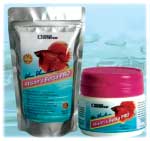
Now you have a male and a female that are healthy. The healthy male can be recognized by its bubble nest. If there is a bubble nest in the male bottle while pairing, it means that it is healthy. The healthy female is alert and normally has a big belly and on most occasions has vertical stripes on her belly. Give them plenty of food for their last meal, at least 2 hours before you put them into the spawning tank. We recommend the use of Atison's Betta PRO during the whole conditioning period. |
 |
 |
Since the female has to be in the spawning tank for about 2 days while the male has to be in it for at least 5 to 6 days without food, you must give them plenty of good food prior to the spawning. Phumchoosri never gives them food during spawning because it will create a bad habit for them in the next spawning. They will get used to eating during spawning, and if they are without food, they will eat their eggs and fry which you cannot use any more. |
He puts both of them in the spawning tank with his hands but avoids touching the water in the bottle because he wants the spawning water to be of superior quality without debris from the old bottles. It is very important to add Atison's Betta SPA wild almond leaf extract as it will help incite spawning and will improve the quality of the bubble nest.
Cover the spawning tank with a piece of cardboard and leave it for about two days. In the first few hours, the male will build a bubble nest under some floating leaves put in the tank (almond leaves are a good choice). You can also use a feeding station of which the size is perfect for this purpose. While he builds the nest, he sometimes chases the female and then comes back to build the nest again.
After a couple of hours, the nest is ready and the male will try to chase the female to go under or near the nest and then the spawning begins. The session will last about 4 hours. Sometimes both of them will help each other collect eggs to the nest. When the spawning ends, the male will chase the female away. It is now time to take the female out and take good care of her. She will be able to spawn again after 16 days. |
| The eggs will hatch within 36 hours if the temperature is about 80� Fahrenheit. The fry live on their yolk sac for another 2-3 days, and after this they need to be fed immediately. The male has completed his duty, and it is time to take him out gently with your hand. The step you should do immediately after taking the male out is to feed the fry. Immediately is stressed because the fry of the first batch will be about 4 hours older than the fry of the last batch. The yolk sacs are gone, and they need food right away. If you delay the feeding for another 4-5 hours, the first batch will become weaker and weaker until they can not move to get or catch food. They will die several days later of starvation. |
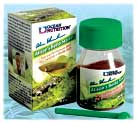
Phumchoosri has developed, together with Ocean Nutrition, a special starter food to give to the fry which is called Atison's Betta Starter. The best is to feed them a very small quantity each time, twice a day. Avoid using live feeds as this can contaminate the fry. In any case, the best is to use the starter feed as the first food and abstain completely from live food: the starter food has everything the fry needs to grow. Do not mix live food and the starter food, as this will confuse the newborn fry.
|
 |
The spawning session is now completed. Hundreds of fries swim on the surface of the water.
Reference: atisonbetta.com |
|
|
|
|
|

|
|
|
|