Single Species Aquariums
Chris Deer |
Most aquariums house numerous types of aquarium fish but there are some species that actually do best when either kept alone or housed with members of its own species. Many of these types of fish do not require much space and can survive on basic filtration systems like Biowheel filters or simple canister filters that include a biological media. If you have a smaller aquarium stuck in a closet, perhaps you could try setting it up for housing a single species like the ones listed below.
|

Tetraodon nigroviridis |
Freshwater Green Spotted Pufferfish
Now isn�t he cute! Looks can be deceiving when it comes to the Green Spotted Pufferfish. We encounter customers that are sold these �cute� pufferfish to go into their community home aquarium |
by other stores on a regular basis. Usually within a couple of days, fish are suddenly missing or at least parts of the fish are missing. These small pufferfish are perfect candidates for a species aquarium. Even a 5 or 10 gallon aquarium will house a couple of these biting cuties. We suggest using a small biowheel filter, regular gravel with some seashell material mixed in to keep the pH slightly alkaline and a quality aquarium heater. Keep about 1 teaspoonful of aquarium salt per gallon of water as these fish do best with some salt added to the aquarium. Feed these little monsters a diet of frozen shrimp, squid, pellets and an occasional snail and or fiddler crab to keep their beak- like tooth from overgrowing. These are hardy little pufferfish when kept in the correct environment. Never keep these fish with other types of fish.
|
African Clawed Frogs
Here is another one of those animals that is sold to unknowing individuals to be kept in their community aquarium. These frogs will eat anything that will fit into their mouths! The bigger the frog grows, the bigger the fish it can consume. Found in both brown and albino forms, these frogs are best kept either alone or with larger fish they cannot fit into their mouths. |
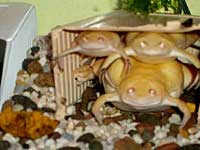
Xenopus laevus |
We recommend these for a species aquarium of at least 10 gallons.They can be kept singly or in groups but be sure they are all the same size. Smaller frogs will be eaten by the larger ones! These frogs grow about to the size of the palm of your hand. They spend their entire lives in water but will jump out of the aquarium if it is not covered. These frogs live in water but must come to the surface to take in air. Give them a cave or two in an aquarium with a simple biowheel filter or canister filter and a quality aquarium heater.
Over time, these frogs become quite tame and will accept food from your hands. It is fun to watch them tackle a live earthworm though they will eat any meaty food item that reaches the bottom. Their front arms have non-webbed fingers they use to grab food items (like your
other fish) and their rear legs are muscular with wide webbed feet that can quickly propel them forward enabling them to capture prey. Each back foot has three sharp claws that give them their common name. These frogs are long-lived and extremely hardy. They become a friendly pet once established.
|
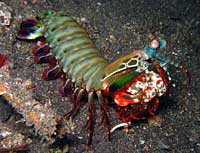
Odontodactylus scyllarus |
Peacock Mantis Shrimp
If you want to have a true hunter and killer for an aquatic pet, the mantis shrimp fits the bill. These predatory shrimp are notorious for killing anything that is housed in the same aquarium with them! Mantis shrimp are extremely intelligent and swift hunters. Rarely, a damselfish will be allowed to live for a period in the same aquarium though its life will be miserable. Mantis shrimp should be kept in at least a 10 gallon aquarium with live rock (for |
the biological filter) and a quality mechanical filter.
The aquarium owner must use caution when cleaning the aquarium as this shrimp can easily slice your finger wide open. We suggest a magnetic algae scraper for safety. This shrimp does need good water quality so regular partial water changes about twice per month is suggested. Mantis shrimp will eat ANY meaty food offered whether it is live or frozen. If fed live foods, use a variety of choices like fiddler crabs, grass shrimp (ghost), hermit crabs and mollies. The hunt is something to witness as this shrimp seems to appear out of nowhere when it strikes its prey. The peacock mantis pictured is the most colorful of the mantis shrimp group (and one of the largest growing).
|
Anglerfish
There are numerous species of anglerfish available to the aquarium trade but we chose this species here due to its relatively inexpensive price and regular availability. This anglerfish gets its name from the sargassum weed its color pattern mimics. This is the perfect solitary fish for a 20 gallon or larger marine aquarium decked out with live rock (for biological filtration), a quality aquarium |
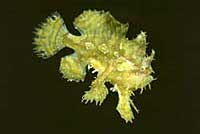
Histrio histrio � Sargassum Anglerfish |
| heater, lighting for growing macro-algae and a basic mechanical filter (hangon or canister filter). This is another one of those fish that becomes much like a house pet once it becomes established. This fish is extremely hardy as long as you do not overfeed it. This anglerfish prefers live foods like live shrimp and live fish though it can be enticed into eating frozen foods by wiggling it in front of its face using a tong or other device. Anglerfish will actually eat themselves to death so only feed it small amounts of food about every other day. By allowing macro-algae to grow on the live rock, you will be able to enjoy the anglerfish�s ability to change its color depending on where it is in the aquarium. Use caution if keeping two of these fish together as they can swallow food items as large as themselves! |
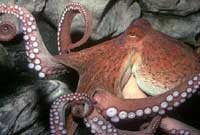
Octopus |
Octopus
Likely one of the most amazing aquatic creatures, the octopus is also one of the most intelligent creatures you can have in an aquarium. We suggest no smaller than a 30 gallon aquarium for housing one of the smaller species of octopi. The aquarium should have plenty of live rock stacked about for which the octopus will |
create its lair. These are powerful animals that can push open aquarium lids or even escape from the smallest of holes in the top. We recommend taping the lid closed and cutting any openings for filtration as tight as possible. A canister filter works best for an octopus aquarium as it will have the fewest escape routes. You will want to super glue the strainer to the intake tube to prevent the octopus from pulling it off and possibly being damaged by the intake of the filter.
These animals love to hunt so offer them several different food choices to challenge its intelligence. Placing food items inside containers with lids will give your octopus a chance at figuring out the puzzle to get its food. Snails, hermit crabs, fiddler crabs, damselfish and the like all make good food choices for an octopus. These animals have a short lifespan whether living in the wild or in the aquarium (about 2 years). Purchase the smallest specimen possible to ensure you will have him for the longest period possible. |
Tank-Bred Seahorses
When only wild-collected seahorses were available, we never suggested them for the home aquarium. Now, tank bred seahorses are readily available that eat many types of frozen foods. This is an animal that should be kept in a species tank not due to aggression but due to the lack of aggression. If housed with other fish, seahorses nearly always starve to death as they are not quick enough to compete with fast |
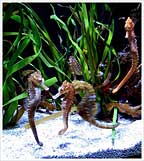 |
swimming fish that consume most of the food before the seahorses can make their way to it. A couple of seahorses can be housed in a 20 gallon aquarium complete with live rock and plenty of macroalgae growth. All frozen food items should be soaked in vitamins before being fed to your seahorses to ensure they are getting a nutritionally complete diet. If fed only brine shrimp or even only mysis shrimp, your seahorses will not get everything they require from the food. A canister filter makes a good filter for a seahorse aquarium along with a quality aquarium heater, sand bottom and perhaps marine snails for helping to keep the aquarium clean of uneaten food and problem algae. Partial water changes every two weeks are recommended to keep water parameters in check.
|
|