|
|
News & Reviews Article
| Title |
The EcoSystem Aquarium Revisited |
| Author |
Mike Paletta
|
| Last Updated |
2014-12-13
|
| Abstract |
I have experimented with virtually every system available, with my goal being to achieve
the most successful reef tank possible with the least of amount of work to maintain it. Like
most reefkeepers, I would rather spend my time looking at my tank than working on it. For
this reason, the Ecosystem Aquarium method is quite appealing. It produces a successful
tank that needs much less equipment to set it up and less effort to maintain it relative to
most of the systems I have seen. For this reason I took another trip to Southern California
to assess how well the system was working at the six month mark.
|
|
|
The EcoSystem Aquarium Revisited
by Mike Paletta-Aquarium Frontiers On-line, Dec. 1997 Feature
One way I judge how an article has been received is by how many letters or phone calls I
get about it. Judging by the number of requests for more information on the Ecosystem
Aquarium Filtration method, developed by Leng Sy, that I have received since writing
articles in both Aquarium Fish Magazine (November 1997) and SeaScope (Fall 1997), I
really struck a nerve. There are probably a number of reasons for this, but perhaps the
biggest is the simplicity of the system itself and the little amount of maintenance that is
required.
I have experimented with virtually every system available, with my goal being to achieve
the most successful reef tank possible with the least of amount of work to maintain it. Like
most reefkeepers, I would rather spend my time looking at my tank than working on it. For
this reason, the Ecosystem Aquarium method is quite appealing. It produces a successful
tank that needs much less equipment to set it up and less effort to maintain it relative to
most of the systems I have seen. For this reason I took another trip to Southern California
to assess how well the system was working at the six month mark.
For those of you not familiar with the Ecosystem Aquarium method, more detailed accounts
can be found in the references mentioned above. But, let me try and bring everyone up to
speed here with a brief description of how the system works. Like most methods of reef
filtration this method starts off in a similar manner. Water is drawn off the top of the tank
via an overflow box, where it flows into the sump. But, it is at this point that the heart of
the Ecosystem method kicks in. The tank water first flows into a narrow chamber that
contains biobaslls. The bioballs are submerged, not dry, and they act primarily to break up
any large pieces of detritus, as well as to dissipate any large air bubbles that are caused by
the water splashing down. The water then flows out through two outlet slots near the
bottom of a partition and into the main filtration chamber.
This central chamber is where all of the filtration occurs, and it contains two separate
components that work synergistically with each other. In the bottom of this chamber,
and running from front to back, are four 2-inch high partitions. Leng's special "mud" substrate
rests within these partitions. This mud is the crucial component that Leng has been working
on over the last six years. The mud itself is not inert- it is full of worms, copepods, nematodes and so on from the live rock, which have now populated it. Leng said that over the years he had tried numerous types of mud, but that the formulation he is now using seems to be the crucial element in the system. He feels that this media performs many functions, which I will elaborate on below.
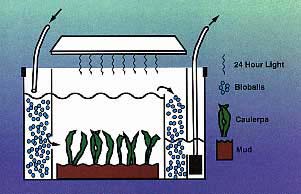
Resting on the mud in the chamber is a large be of Caulerpa sertuloides. I know many of
you reading this know of my general disdain for algae in the reef tank, and my opinion
that algal turf scrubbers are not the optimal method for filtering a closed reef system. The
reason for these opinions is that in the past when algal scrubbers were used for filtering
reef tanks, I have seen several problems invariably arise. First, turf algae has a tendency
to overgrow the tank as it moves from the scrubber to the tank itself over time. Second, in
most tanks using algal turf scrubbers that I observed, The algae released yellowing
compounds into the water that not only reduced the passage of light, but also seemed to
produce negative effects on the corals, particularly small-polyped scleractinain (SPS)
corals.
In addition, on some tanks I have seen that use this type of filtration system, the pH of the
tank fluctuated widely between night and day because of the algae releasing or consuming
CO2. For this reason, many new algal filtration systems recommended lighting the algal
tank in a reverse manner from when the main tank is illuminated.
Also, in some tanks with high algal loads the algae outcompeted the corals for some of the
trace elements present. Finally, in most turf scrubber systems it is necessary to frequently
remove the algae in order to rid the tank of excess nutrients, and endeavor that is often
labor and time intensive.
Despite all these negatives regarding algal filtration, I am positive about the Ecosystem
method, for several reasons. First, the algae in the system is illuminated 24 hours per day
by four fluorescent tubes-the lights never go off above the sump. This has caused some
interesting results.
The wild pH fluctuations that I have seen on other systems do not occur in this system. The
pH bottoms out at 8.2 one hour prior to the lights being turned on for the main tank, and it
rises to a maximum of 8.4 one hour prior to the light in the main tank going off at night.
Also, after several years of growth in each system, the Caulerpa in the filter has never
crashed and gone into sexual production. As a result, none of it has found its way into
Leng's main tank, which has been a problem in some other algae filtration systems. This
may also be a function of the species of Caulerpa he has chosen - Caulerpa sertuloides.
Even more interesting than the things I've mentioned so far, however, is seeing how
crystal clear the water is. In many reef tanks I've seen that contained even small amounts
of algae, the water would become yellow over time. However, in Leng's tanks the water is
crystal clear. Again, this may be a result of the 24-hour light cycle, because by not having
a dark cycle the production of gelvin (yellowing compounds) - which is thought to be a
product of the chloroplasts of the algae breaking down at night and being released into the
water- may be prevented. Lastly, for reasons still unclear to me, this algae has never
outgrown the filter and thus never needed to be harvested or removed. From what I've
seen there is little maintenance involved in running this system.
Once the water passes through the Caulerpa it flows over a partition, through slots near
the bottom of a second partition and into a chamber containing bioballs, where it is
pumped into the main tank. These last bioballs act to prohibit any Caulerpa from being
drawn into the pump and fed into the main tank. The amount of water flowing through the
filter is approximately three times the volume of the tank per hour.
All this may not sound like anything revolutionary, but upon seeing the tank and the corals,
and also the fish, I do indeed feel that this methodology for successful reef husbandry has
merit. In particular, not only are the corals thriving, but the fish are as well. In this system
all of the fish have colors as vibrant as the day they were collected, even though many of
the tank's inhabitants have now been in the system for six years or longer. In addition, this
system has demonstrated an ability to reduce and even eliminated ongoing lateral line
disease in some fish, and to restore the coloration in other fish that have faded over time.
I will discuss this at the end of this article.
Besides the overall health of the inhabitants in the system, there are some other
advantages to this method as well. In terms of maintenance, Leng's tank requires less than
just about any other system I have seen. The tanks contain no substrate in order to easily
remove the detritus that settles out during the week. Once a week Leng siphons out 10
gallons of water to remove as much detritus that has accumulated as possible. To further
reduce the detritus buildup, the current in these tanks is quite strong. In the 400-gallon
SPS tank there are powerheads and circulation pumps producing more than 4000 gallons of
circulation per hour, which keeps detritus in suspension so that it can find its way to the
filter. No doubt this strong water movement also helps to explain why the corals are
growing so exuberantly, and polyp extension is so great. In his 120-gallon soft coral tank
the water circulation is approximately 1500 gallons per hour.
Other than removing detritus weekly the only other maintenance that is performed on this
system is the addition of calcium in the form of calcium hydroxide and buffer. These are
added to maintain calcium above 400 parts per million (ppm) and alkalinity above 2.5
milliequivalents. Other than that, this system virtually runs itself. To date, neither iodine or
strontium have been added, and this has not produced any deleterious effects on the corals.
Combining the Caulerpa with the mud has also produced a system in which virtually no
microalgae-inducing nutrients are present. During a two-month testing period, ammonia,
nitrite and nitrate were tested daily and remained a 0 ppm, while phosphate showed only a
trace at 0.1 ppm.
Needless to say, this system raises a lot of questions. The most common is, "what's in the
mud?" I would love to tell you, but Leng has patented this compound, and the entire
system for that matter. Also, I don't really know. What I can tell you, however, is that the
mud itself is not a homogeneous mixture. In fact, it seems to have three distinct
components. There is large-particled calcareous portion, a sandy component and a light,
silty component that seems to "float" around the other two. Also, upon viewing the sumps
on Leng's tanks I noticed that the mud seemed thicker than when I saw it six months ago.
Leng said that this was indeed so. The mud usually increases in depth by at least a 1/2-
inch per year. Therefore, one other function of the sump is to act as a settling chamber
because much of the detritus that remains in suspension settles here.
Other aspects of the system that stick in my mind include the large amount of growth that
occurred in the inhabitants of the tank, especially in the SPS corals. In fact, on my trip six
months ago, Leng and I split two fragments of different corals. While these corals have
doubled in size in my tank, in Leng's tank the growth rate was even greater. Part of the
reason for this may be the large quantity of calcium that Leng adds to his SPS tank. When I
previously visited Leng, all that I knew was that his tank parameters for alkalinity and
calcium were quite reasonable-- I did not know how much of anything he was adding to
keep these levels.
Leng adds 1 rounded tablespoon of buffer to his 400-gallon tank daily. These quantities
equal approximately 50 grams of calcium hydroxide per week and 20 grams of buffer.
Interestingly, neither calcium nor buffer are supplemented in the soft coral tank. The only
additional calcium that gets into this tank is what occurs during the weekly 5-gallon water
change.
Another interesting observation of these tanks is that, despite these differing calcium
supplementation schedules, the rock in the soft coral tank is covered in coraline algae, while
the rock in SPS tank has none. Because both tanks began with the same rock and have
approximately the same amount of light a possible explanation could be that in the SPS
tank, in spite of the large addition of calcium, the SPS corals are outcompeting the algae
for available calcium.
Another possibility for why the corals are growing so fast is the availability of food in the
form of plankton. After closely observing a water sample, it was clear that some plankton
is present in the water. Because no skimming is used, this may allow some of the plankton
to survive. However, as previously noted, the mud is teaming with life, so obviously some
of the offspring form this life is making its way into the tank.
Another hypothesis has also been postulated. Because the Caulerpa is not growing fast and
does not need to be harvested, the corals are doing well because the water contains a
great deal of nutrients that are helping to fuel the coral's growth. This may be true for the
soft corals, which have been shown in some instances to prefer water that contains more
nutrients. However, from everything I have read, SPS corals seem to do best in cleaner,
well-oxygenated water. Leng's explanation for why his SPS tank is doing so well is that the
Caulerpa is only necessary to remove the nutrients that are maintained at low levels due to
the weekly water change. This water change is not simply removing water from the top of
the tan and replacing it, but rather, Leng is meticulous in removing as much detritus as
possible-which is a considerable amount - during the water change. By doing this Leng
feels that he is removing the nutrient sink of phosphate an nitrate that otherwise would
accumulate in this system and eventually lead to algae overgrowth. While I may have
underemphasized this is in previous articles, Leng made it a point for me to stress the
importance of this.
Leng has also pointed out that in some applications, the mud may have a downside. Leng
told me that last year he had a problem with rapid tissue necrosis and that it was very
difficult to control. Because of the presence of the mud, Leng thought it may have acted as
a reservoir for the bacteria. To combat this problem Leng has added an ultraviolet (UV)
sterilizer to prevent bacteria in the mud from being reintroduced into the SPS tank. It
should be noted that no UV sterilizer is present on the soft coral tank, and there has never
been a problem in this tank.
I have now had my own Ecosystem Aquarium tank running for two months, and the system
is working as I had expected. My 90-gallon tank is mixed tank that contains both hard and
soft corals (to test the system as best as I can), as well as large population of fish. For the
first two weeks after adding the mud to the sump there was some slime algae on the live
rock, but this has since disappeared. At that time I added the Caulerpa and it has been
growing ever since. I should add that I "cheated" when I set up this system in that I used
cured live rock.
I did this in order to try and get the system up as quickly as possible. In discussions with
Leng it is apparent that when "fresh" live rock is added it may initially overwhelm the
system if a large amount of die-off occurs. Therefore, in order to properly cure the rock it
may be necessary to use a skimmer during this early phase. I should note that the
Caulerpa I added was beginning to show signs of dying when I initially placed it in the mud.
I weighed it down using small pieces of live rock, and after a few days it had all recovered.
The last aspect of Leng's system I would like to mention is that it also boasts one of the
healthiest assortment of fish I have seen. Leng's tanks are not restricted in terms of the
types of fish they house either. His SPS tank has a flamingi tang, three purple tangs, a
squirrellfish and numerous other large fish, while his soft coral tank contains three black
tangs among it inhabitants. Also, equally impressive is his fish-only tank, which houses
numerous adult angelfish, butterflies and tangs. This tank uses live rock for decoration and,
once again, the only filtration used is the Ecosystem Aquarium filter. Needless to say, all of
the fish in this fish tank were healthy, so this system may also be useful in fish -only
applications.
When looking at this system in all of its various applications, the question arises as to why
does this system work. I have discussed this in depth with Tom Frakes, and we have come
up with the following hypothesis. To begin with, the major flaw of algae scrubber systems
is that when the algae take nitrates out of the water, they convert them along with CO2
into organics that color the water and inhibit the growth of the corals. The plenum-type
systems seem to work better. When properly set up, they remove the organics from the
water to provide a food source for the bacteria present in the anoxic bed, while at the same
time converting nitrate into nitrogen gas. Unfortunately, in most of our tanks, we cover too
much of the substrate wit rock, so this prevents the system from reaching its full potential.
In Leng's system, because of the close proximity of the algae to the special substrate, the
nitrate and organics are efficiently removed.
The key, however, seems to be in the compounds in the mud. These seem critical for the
growth of the Caulerpa. In fact, Leng has told me that the current mud is his fourth attempt
at a substrate with the proper characteristics over the past seven years.
I realize that it is still too early to proclaim this system as the be all and end all system. As
we have learned far too often in the past, a methodology is not fully tested until it has been
run on a tank for at least two years. However, after viewing Leng's tanks, which have been
set up longer than this, there is a strong possibility that this system may work in the long
term. Because my own tank has only been in operation for two months, we will have to wait
and see. Until more people try this system, however, and discuss its merits and shortfalls,
I'm afraid that I will still constantly be asked, "What's in the mud?"
Download The EcoSystem Aquarium Revisited PDF

|
|
| Products related to this article |
|
|
|
|
|
|
|
|
|
|
|
|
|
|
|
|
|
|
|
|
|
|
|